 |
| |

|
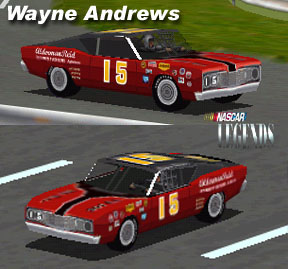
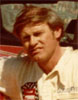
Wayne Andrews
A NASCAR Legend
The story of Grand National racing in 1970 is really the story of the independent driver. The big dollar corporations had not yet stepped in to create "teams" who ran billboard cars that looked like a logo on wheels. There were a few teams that had factory backing, but "the factories" were the car factories and the car shape was all the billboard there was. And there were very few of those cars to go around. Matter of fact, there were only enough to "go around" 6 or 8 drivers at a big race like the Daytona 500, and maybe only 2 drivers ran factory cars at the races at Hickory or Bowman-Gray or most of the races that made up the 48 race schedule.
The truth is, almost all of the drivers who ran in '70 had one car. Sometimes that driver owned it too. Sometimes the car was owned by someone else. But a lot of the names we remember from the past were only painted on one car.
|
And a lot of the boys who ran in these early Grand National races ran other places most of the time. They were boys without the "budget" to make it all the way out to Riverside or up to Dover. Heck, they were boys whose budget was called "money". You had enough, or you didn't. After you put it into the car that is.
Like I said, most boys ran the tracks at home and worked their way up as they got better. Working your way up not only meant entering the bigger races, it also meant making or getting a better car.
|
|
And a lot of the boys who ran in these early Grand National races ran other places most of the time. They were boys without the "budget" to make it all the way out to Riverside or up to Dover. Heck, they were boys whose budget was called "money". You had enough, or you didn't. After you put it into the car that is.
Like I said, most boys ran the tracks at home and worked their way up as they got better. Working your way up not only meant entering the bigger races, it also meant making or getting a better car.
One driver who ran some in Grand Nationals in the early '70s, ran mostly the Grand Americans and the local series around his Siler City, North Carolina home. He made a big name at home, and a really big name in Grand Americans, so when Bill France mixed the GA's with the GN's, it was time for this boy to try his luck actually, not just his luck, but his skill too. He'd made enough "budget" to try 'em out.
Wayne Andrews ran at Bowman Gray in his first outing. He qualified 4th in a Reid Shaw owned car. Some mighty big names started that race behind him. He ran pretty good and the two men came home with a whopping $275 from their top ten finish. One reason it was hard to make the races back then was because they didn't exactly pay big bucks. Also, a select one or two drivers at that race got appearance money, probably about $1,000 or so, while the independents got zip.
It was pretty hard to be competitive with the big boys when they got some and you got none. It bugged the independents so much that they would stage a "park out" at Ashville-Weaverville where all but about 5 drivers simply ran a few laps, then loaded their cars up and watched. But that's another story.
Wayne also ran at Ona, West Virginia. He picked up $340 there. At Columbia, he qualified 5th, came home 6th and made $300. The next GN race after Columbia was ONE DAY LATER at Hickory. He finished 5th to pick up $325. Not much money in those days, right? The big payday of the year was at Macon and netted $454. Richard Petty would refuse to show up for one race because the promoter decided not to pay the $2000 appearance. Nobody blamed Petty for his stand because it made a lot of sense but it didn't make sense that the show included a bunch of drivers who were getting nothing.
Speaking of Petty. He has a very famous car sitting in his museum. Why is it famous? Well, of course, because he drove it, right? Since it's the only Ford he drove while his name was almost better known than the Plymouth name on the cars he piloted, it is fairly important historically. So what about that car? He only drove it that one year.
What most don't know in this modern era, is that the cars were part of the "backing" that drivers got from the factories back then. That car was probably "given" to Petty by FoMoCo. And he only ran it a year and then left Ford. Ford may have either taken it back (and pouted about the shortness of the deal) or demanded that the Pettys pass that car on to another Ford "backed" driver, Benny Parsons. Or maybe they simply asked the Pettys to please let Benny buy it. After all, you really shouldn't be mad at Petty for being smarter than Ford or Plymouth, or for doing what he had to do to make a living.
So that Ford in the Petty museum was driven by two Champions, not one, right? Wrong, it was driven by THREE. You see, Benny passed it on. A Grand American champ got it from Benny. Wayne ran it as a Mercury Montego. And that is the car pictured here and that we have for you to plug into the NLegends game. Quite a car, right? Truth is, so were the drivers. Have fun with the car....
 |
Wayne
Andrews
'69 Grand American Rookie of the Year
'72 Grand American Champion
Ran Grand National and Grand National East
Download
#15 Mercury Montego
Author: Kent |
|
We would like to thank Kent for taking
the time to research and design, this car and article for NASCAR Legends.
Also for allowing us the opportunity to post it here so you may all enjoy
it. He is doing a wonderful job of improving this sim, and is noticable
from his work, he has really done his homework to come up with the
accurate paint schemes for this era. Keep up the good work.
|
|
| |
|
|
|
PTRW
2014 Race 19 Standings
| Pos. |
Player |
Points |
| 1 |
Zone15 |
3179 |
| 2 |
Josh O'Brien |
-140 |
| 3 |
Blue_Oval_Hero |
-412 |
| 4 |
InTheWallace |
-424 |
| 5 |
br329 |
-510 |
| 6 |
gr8eske1 |
-529 |
| 7 |
Wingz |
-554 |
| 8 |
benjiwarhol |
-626 |
| 9 |
DaleJrFan8 |
-648 |
| 10 |
NOLA88 |
-739 |
|
|
|
|
|


